► STATISTICS ON REGIONAL REFUNDABLE AND NON – REFUNDABLE PARLIAMENTARY NOMINATION FEES

The threshold of more than 12.5% of total Valid Votes determined the qualification and disqualification of Parliamentary Candidates who contested in the Parliamentary Elections in 7th December 2020 in Ghana. Source of data is from the Parliamentary Elections Results 2020 (Gazette).This is a provision of the Law specified in Regulation 46 (3a) of the Public Elections Regulations, 2020.

Only the four (4) political parties of the New Patriotic Party (NPP), National Democratic Congress (NDC), Progressive Peoples Party (PPP) Peoples National Congress (PNC) recorded parliamentary candidates who qualified for more than 12.5% refundable parliamentary fee. The two major Political Parties of the New Patriotic Party and the National Democratic Congress did not record 100% refundable parliamentary nomination fees because of the stronghold regions of these two parties. It is also important to note that the strong performances of some Independent Candidates denied affected N.P.P and N.D.C Parliamentary Candidates their qualification for refundable parliamentary nomination fees. As a result, the N.P.P recorded refundable Parliamentary nomination fees in 271 constituencies whereas the N.D.C in 269 constituencies. It is a fact that the strongholds of the N.P.P and the N.D.C, in the Ashanti and Volta regions, greatly influenced the 4:6 ratio of non – refundable parliamentary nomination fees with a difference of two (2) constituencies.

The 2020 parliamentary nomination fee was GH¢10,000.00 and recorded a total of eight hundred and eighty (880) candidates with refundable nomination fees for five hundred and Sixty seven (567) parliamentary candidates and three hundred and thirteen (313) as non – refundable. This represented 64.43% and 35.57% respectively of total parliamentary candidates. It is important to note that the higher percentage of qualified parliamentary candidates with more than 12.5% refundable nomination fees determines the levels of popularity and strength in respective contested constituencies.

Of the total parliamentary candidates of five hundred and Sixty seven (567) who qualified refund of their nomination fees, four hundred and ninety two (492) are males and seventy five (75) are females. This represented 86.77% and 13.23% as males and females respectively.

Of the three hundred and thirteen (313) non refundable parliamentary candidates category, two hundred and sixty four (264) are males and forty four (44) are females. This represented 84.35% and 13.65% as males and females respectively.

It is important to note that the higher percentage of qualified parliamentary candidates with more than 12.5% refundable nomination fees determines the levels of popularity and strength in respective contested constituencies. A whooping amount of five million, six hundred and seventy thousand Ghana Cedis (GH¢5,670,000) is to be refunded to qualified party parliamentary candidates of the New Patriotic Party (NPP), National Democratic Congress (NDC), Peoples National Congress (PNC) and the Progressive Peoples Party (PPP), as well as twenty two (22) qualified Independent parliamentary candidates.

However, three million, one hundred and thirty thousand Ghana Cedis (GH¢3,130,000) was forfeited to the state for obtaining valid votes less than or equal to 12.5% of total valid votes in contested constituencies. Clearly the performances of these affected parliamentary candidates show their low level of popularity and the need to re-strategize and improve their chances to qualify for refund and even win the parliamentary seats in future parliamentary elections.

REGION: VOLTA

NORTH TONGU  – NPP Did not qualify for refundable parliamentary nomination fee.

AGOTIME – ZIOPE – NPP did not qualify for refundable parliamentary nomination fee.

SOUTH DAYI – NPP did not qualify for refundable parliamentary nomination fee.

KPANDO – NPP did not qualify for refundable parliamentary nomination fee. One of the two independent candidates qualified.

REGION: ASHANTI

FOMENA – NDC did not qualify for refundable parliamentary nomination fee. Independent parliamentary candidate who qualified was the former MP for the NPP.

BEKWAI – NDC did not qualify for refundable parliamentary nomination fee. Independent parliamentary candidate qualified.

SUAME – NDC did not qualify for refundable parliamentary nomination fee. Independent parliamentary candidate qualified.

KUMAWU – NDC did not qualify for refundable parliamentary nomination fee. Independent parliamentary candidate qualified. 

BANTAMA – NDC did not qualify for refundable parliamentary nomination fee.

KWADASO – NDC did not qualify for refundable parliamentary nomination fee.

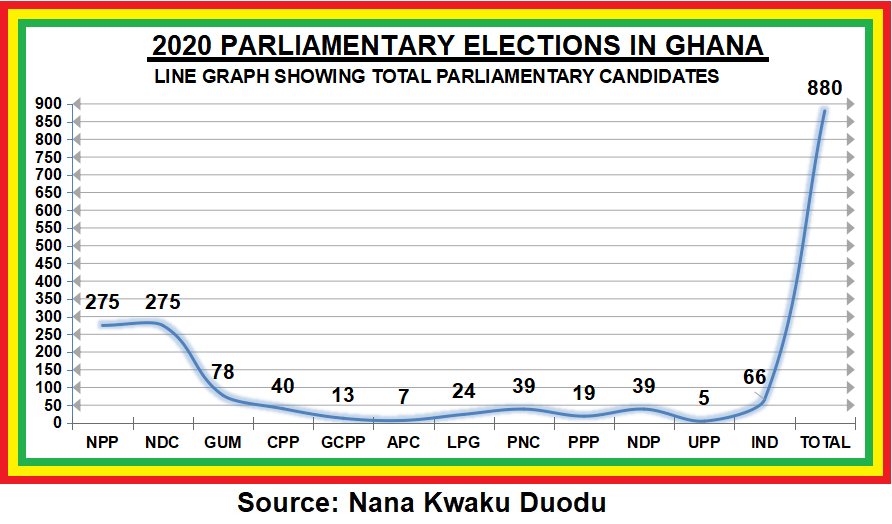
It is important to note that Parliamentary Candidates filed by the eleven (11) political parties of the N.P.P. NDC, GUM, C.P.P, G.C.P.P, A.P.C, L.P.G, P.N.C, P.P.P, N.D.P, and the U.P.P determined their strength and popularity levels at contested constituencies in the Sixteen (16) regions of Ghana. A stronger and more objective determination is the refundable and non – refundable parliamentary nomination fees of these Parliamentary CandidatesThe results of the 2020 Parliamentary Elections showed that 64% of the Eight Hundred and Eighty (880) Parliamentary Candidates qualified for more than 12.5% threshold of refundable nomination fees. Since this is more than the measuring result of 50%, it is argued that a greater number of Parliamentary Candidates (Party and Independent) had strong campaign messages and popular with the voter population. In the same vein, 36% non – refundable parliamentary nomination fees of the Eight Hundred and Eighty (880) Parliamentary Candidates (Party and Independent) is an indication of weak campaign messages and low popularity with the electorate.   

The dominance of the N.P.P and the N.D.C was very strong in 271 and 269 constituencies respectivelyThese two major political parties recorded 99% and 98% refundable parliamentary nomination fees in the 275 constituencies. This shows their high level strength and popularity among the voter population having recorded more than 50% measuring result in the 2020 Parliamentary Elections.

It was weak for the P.N.C in the Upper East and Upper West Regions in three constituencies with three (3) Parliamentary Candidates with refundable nomination fees. The Party recorded 8% refundable nomination fees (GH¢30,000.00) of the thirty nine (39) Parliamentary Candidates who contested the elections in thirty nine (39) constituencies of the sixteen (16) regions. It is important to note that the P.N.C contested only four (4) constituencies of the fifteen (15) constituencies in the Upper East Region, and two (2) constituencies in the Upper West region and won 50% each of the refundable parliamentary nomination fees.  

The P.P.P recorded parliamentary refundable nomination fees of GH¢20,000.00 in two (2) of the four (4) constituencies of the Central and Volta Regions. This showed 11% of the total nineteen (19) parliamentary candidates in (19) constituencies. In these two regions, the party recorded 50% each refundable parliamentary nomination fees of the two (2) candidates respectively. It is important to note that the party contested the parliamentary elections in twelve (12) of the sixteen (16) regions unlike the Ashanti, Western North, Ahafo and North East regions.

Analytically, the measurement of refundable parliamentary nomination fees for the P.N.C and P.P.P are the same in terms of 50% collection of nomination fees in respective regions and constituencies qualified.     

The performances of the other Political Parties with no refundable parliamentary nomination fee show their poor and weakening positions and popularity in the contested constituencies. If these political parties could not qualify for refundable parliamentary nomination fee in at least one (1) constituency, then their strength and popularity is very low. The only way for these very weak political Parties to be strong, recognized and rewarded in the constituencies is to build strong party offices with pragmatic political activities that have a direct bearing in the development of the people (Political Parties Law 2000, Act 574).

Though Ghana’s General Elections seem to show the dominance of the two political parties of the New Patriotic Party and the National Democratic Congress, the other political parties with low performances can increase their chances of obtaining more than 12.5% threshold of the total valid votes in respective contested constituency with effective political and campaign strategies. Once a Parliamentary Candidate qualifies for refundable nomination fee, it is a major step to increase chances of winning the parliamentary seat or come close to win it in the next parliamentary election. This is better than waiting for the two major political Parties of the N.P.P and the N.D.C to make major political mistakes and lose support and popularity of the electorate and other Stakeholders. They must learn from successful Independent Candidates with no offices in the constituencies/districts.

With the total number of Sixty Six (66) Independent Candidates, 33% recorded refundable parliamentary nomination fees unlike 66% in Fourteen (14) of the Sixteen (16) regions. Only Ahafo and North East regions did not record Independent Parliamentary Candidates in the 2020 Parliamentary Elections. The strength and popularity of some of the Independent Candidates were evident in the Ashanti and Volta regions, the strongholds of the N.P.P and the N.D.C. Results in constituencies such as Kpando, Fomena, Bekwai, Suame and Kumawu recorded Independent Candidates qualified for refundable nomination fees unlike the N.P.P at Kpando, and the N.D.C at Fomena, Bekwai, Suame and Kumawu.   

Comparatively, the Political Parties with Five Hundred and Forty Five (545) Parliamentary Candidates have a superior urge and dominance over Independent Parliamentary Candidates with Twenty Two (22) recorded 67% and 33% respectively of refundable parliamentary nomination fees. Using the measuring result of more than 50%, the performances of Party Parliamentary Candidates was higher in terms of popularity with organized and systematic campaigns than Independent Candidates. With non – refundable parliamentary nomination fees, results of Forty Four (44) Independent Candidates show weaker positions than Two Hundred and Sixty (269) Party Candidates with 67% and 33% respectively.

Indeed, the principle of universal adult suffrage works in all democracies with the conduct of public elections as part of the electoral system within the framework of the political system. It shows that true power is in the hands of the electorate and they determine whether a candidate wins the election and qualifies for refundable nomination fee or does not win the election but qualifies for refundable nomination fee as established by law.

Source: 2020 Parliamentary Elections Results in Ghana (Gazette)

Writer: Nana Kwaku Duodu

► REFUNDABLE AND NON – REFUNDABLE PARLIAMENTARY NOMINATION FEES

The threshold of more than 12.5% of total Valid Votes determined the qualification and disqualification of Parliamentary Candidates who contested in the Parliamentary Elections in 7th December 2020 in Ghana. Source of data is from the Parliamentary Elections Results 2020 (Gazette).This is a provision of the Law specified in Regulation 46 (3a) of the Public Elections Regulations, 2020.

Only the four (4) political parties of the New Patriotic Party (NPP), National Democratic Congress (NDC), Progressive Peoples Party (PPP) Peoples National Congress (PNC) recorded parliamentary candidates who qualified for more than 12.5% refundable parliamentary fee. The two major Political Parties of the New Patriotic Party and the National Democratic Congress did not record 100% refundable parliamentary nomination fees because of the stronghold regions of these two parties. It is also important to note that the strong performances of some Independent Candidates denied affected N.P.P and N.D.C Parliamentary Candidates their qualification for refundable parliamentary nomination fees. As a result, the N.P.P recorded refundable Parliamentary nomination fees in 271 constituencies whereas the N.D.C in 269 constituencies. It is a fact that the strongholds of the N.P.P and the N.D.C, in the Ashanti and Volta regions, greatly influenced the 4:6 ratio of non – refundable parliamentary nomination fees with a difference of two (2) constituencies.

The 2020 parliamentary nomination fee was GH¢10,000.00 and recorded a total of eight hundred and eighty (880) candidates with refundable nomination fees for five hundred and Sixty seven (567) parliamentary candidates and three hundred and thirteen (313) as non – refundable. This represented 64.43% and 35.57% respectively of total parliamentary candidates. It is important to note that the higher percentage of qualified parliamentary candidates with more than 12.5% refundable nomination fees determines the levels of popularity and strength in respective contested constituencies.

Of the total parliamentary candidates of five hundred and Sixty seven (567) who qualified refund of their nomination fees, four hundred and ninety two (492) are males and seventy five (75) are females. This represented 86.77% and 13.23% as males and females respectively.

Of the three hundred and thirteen (313) non refundable parliamentary candidates category, two hundred and sixty four (264) are males and forty four (44) are females. This represented 84.35% and 13.65% as males and females respectively.

It is important to note that the higher percentage of qualified parliamentary candidates with more than 12.5% refundable nomination fees determines the levels of popularity and strength in respective contested constituencies. A whooping amount of five million, six hundred and seventy thousand Ghana Cedis (GH¢5,670,000) is to be refunded to qualified party parliamentary candidates of the New Patriotic Party (NPP), National Democratic Congress (NDC), Peoples National Congress (PNC) and the Progressive Peoples Party (PPP), as well as twenty two (22) qualified Independent parliamentary candidates.

However, three million, one hundred and thirty thousand Ghana Cedis (GH¢3,130,000) was forfeited to the state for obtaining valid votes less than or equal to 12.5% of total valid votes in contested constituencies. Clearly the performances of these affected parliamentary candidates show their low level of popularity and the need to re-strategize and improve their chances to qualify for refund and even win the parliamentary seats in future parliamentary elections.

REGION: VOLTA

NORTH TONGU  – NPP Did not qualify for refundable parliamentary nomination fee.

AGOTIME – ZIOPE – NPP did not qualify for refundable parliamentary nomination fee.

SOUTH DAYI – NPP did not qualify for refundable parliamentary nomination fee.

KPANDO – NPP did not qualify for refundable parliamentary nomination fee. One of the two independent candidates qualified.

REGION: ASHANTI

FOMENA – NDC did not qualify for refundable parliamentary nomination fee. Independent parliamentary candidate who qualified was the former MP for the NPP.

BEKWAI – NDC did not qualify for refundable parliamentary nomination fee. Independent parliamentary candidate qualified.

SUAME – NDC did not qualify for refundable parliamentary nomination fee. Independent parliamentary candidate qualified.

KUMAWU – NDC did not qualify for refundable parliamentary nomination fee. Independent parliamentary candidate qualified. 

BANTAMA – NDC did not qualify for refundable parliamentary nomination fee.

KWADASO – NDC did not qualify for refundable parliamentary nomination fee.

It is important to note that Parliamentary Candidates filed by the eleven (11) political parties of the N.P.P. NDC, GUM, C.P.P, G.C.P.P, A.P.C, L.P.G, P.N.C, P.P.P, N.D.P, and the U.P.P determined their strength and popularity levels at contested constituencies in the Sixteen (16) regions of Ghana. A stronger and more objective determination is the refundable and non – refundable parliamentary nomination fees of these Parliamentary CandidatesThe results of the 2020 Parliamentary Elections showed that 64% of the Eight Hundred and Eighty (880) Parliamentary Candidates qualified for more than 12.5% threshold of refundable nomination fees. Since this is more than the measuring result of 50%, it is argued that a greater number of Parliamentary Candidates (Party and Independent) had strong campaign messages and popular with the voter population. In the same vein, 36% non – refundable parliamentary nomination fees of the Eight Hundred and Eighty (880) Parliamentary Candidates (Party and Independent) is an indication of weak campaign messages and low popularity with the electorate.   

The dominance of the N.P.P and the N.D.C was very strong in 271 and 269 constituencies respectivelyThese two major political parties recorded 99% and 98% refundable parliamentary nomination fees in the 275 constituencies. This shows their high level strength and popularity among the voter population having recorded more than 50% measuring result in the 2020 Parliamentary Elections.

It was weak for the P.N.C in the Upper East and Upper West Regions in three constituencies with three (3) Parliamentary Candidates with refundable nomination fees. The Party recorded 8% refundable nomination fees (GH¢30,000.00) of the thirty nine (39) Parliamentary Candidates who contested the elections in thirty nine (39) constituencies of the sixteen (16) regions. It is important to note that the P.N.C contested only four (4) constituencies of the fifteen (15) constituencies in the Upper East Region, and two (2) constituencies in the Upper West region and won 50% each of the refundable parliamentary nomination fees.  

The P.P.P recorded parliamentary refundable nomination fees of GH¢20,000.00 in two (2) of the four (4) constituencies of the Central and Volta Regions. This showed 11% of the total nineteen (19) parliamentary candidates in (19) constituencies. In these two regions, the party recorded 50% each refundable parliamentary nomination fees of the two (2) candidates respectively. It is important to note that the party contested the parliamentary elections in twelve (12) of the sixteen (16) regions unlike the Ashanti, Western North, Ahafo and North East regions.

Analytically, the measurement of refundable parliamentary nomination fees for the P.N.C and P.P.P are the same in terms of 50% collection of nomination fees in respective regions and constituencies qualified.     

The performances of the other Political Parties with no refundable parliamentary nomination fee show their poor and weakening positions and popularity in the contested constituencies. If these political parties could not qualify for refundable parliamentary nomination fee in at least one (1) constituency, then their strength and popularity is very low. The only way for these very weak political Parties to be strong, recognized and rewarded in the constituencies is to build strong party offices with pragmatic political activities that have a direct bearing in the development of the people (Political Parties Law 2000, Act 574).

Though Ghana’s General Elections seem to show the dominance of the two political parties of the New Patriotic Party and the National Democratic Congress, the other political parties with low performances can increase their chances of obtaining more than 12.5% threshold of the total valid votes in respective contested constituency with effective political and campaign strategies. Once a Parliamentary Candidate qualifies for refundable nomination fee, it is a major step to increase chances of winning the parliamentary seat or come close to win it in the next parliamentary election. This is better than waiting for the two major political Parties of the N.P.P and the N.D.C to make major political mistakes and lose support and popularity of the electorate and other Stakeholders. They must learn from successful Independent Candidates with no offices in the constituencies/districts.

With the total number of Sixty Six (66) Independent Candidates, 33% recorded refundable parliamentary nomination fees unlike 66% in Fourteen (14) of the Sixteen (16) regions. Only Ahafo and North East regions did not record Independent Parliamentary Candidates in the 2020 Parliamentary Elections. The strength and popularity of some of the Independent Candidates were evident in the Ashanti and Volta regions, the strongholds of the N.P.P and the N.D.C. Results in constituencies such as Kpando, Fomena, Bekwai, Suame and Kumawu recorded Independent Candidates qualified for refundable nomination fees unlike the N.P.P at Kpando, and the N.D.C at Fomena, Bekwai, Suame and Kumawu.   

Comparatively, the Political Parties with Five Hundred and Forty Five (545) Parliamentary Candidates have a superior urge and dominance over Independent Parliamentary Candidates with Twenty Two (22) recorded 67% and 33% respectively of refundable parliamentary nomination fees. Using the measuring result of more than 50%, the performances of Party Parliamentary Candidates was higher in terms of popularity with organized and systematic campaigns than Independent Candidates. With non – refundable parliamentary nomination fees, results of Forty Four (44) Independent Candidates show weaker positions than Two Hundred and Sixty (269) Party Candidates with 67% and 33% respectively.

Indeed, the principle of universal adult suffrage works in all democracies with the conduct of public elections as part of the electoral system within the framework of the political system. It shows that true power is in the hands of the electorate and they determine whether a candidate wins the election and qualifies for refundable nomination fee or does not win the election but qualifies for refundable nomination fee as established by law.

Source: 2020 Parliamentary Elections Results in Ghana (Gazette)

Writer: Nana Kwaku Duodu

♥ THE ASCENSION OF JESUS AND YOU

If Jesus Christ promises eternal life with Him in heaven, this is too sweet for me to say no. I say yes (x 7) times.

What is written is written (Luke 10:25 – 28) and what God has said is true about His Son Jesus Christ and must not be challenged (Psalms 119:89). If His prophetic death and resurrection was scriptural and a necessity, then His ascension to heaven was inevitable. A good message to believe in the existence of heaven for Holy Spirit filled believing Christians and the existence of hell for unbelievers and sinners

It happened because the word of God is true and this makes His return to judge the living and the dead sure and believable (John 14:1 – 3, Acts 10:42, 2 Timothy 4:1, 1 Peter 4:5, Revelations 1:7, 19:11 – 16). The book of Luke mentions the town Bethany as the exact place of Jesus’ ascension to heaven (Luke 24:50) unlike the book of Mark (Mark 16:19)

The ascension of Jesus to heaven is proven by the prophetic writings, Psalms and the Law to make it an act of God, beyond scientific (Law of Gravity) and medical analysis (Human Anatomy) (Zechariah 14:4, Psalms 68:18, 110:1, Isaiah 45:23).

It is also proven by the prophetic sayings of Jesus to make His messianic ministry authentic and believable beyond the yearly Easter celebration; also confirms Him as the Son of God and the Christ (Luke 24:44).

The appearance of the two angels who spoke and confirmed Jesus’ resurrection to heaven and return in like manner reveals the power of God to redeem His Son from the earth and make Him sit at the right hand of Majesty (Acts 1:9 – 11). For what is divine is divine and what is earthly is earthly.

It is about the exaltation of Christ and the exaltation of the Church. It is about Christ’s authority by the right hand of the Father to enforce His will on earth through the Holy Spirit and the Church (Ephesians 1:15 – 23).   

The Church must behave exactly like the disciples of Jesus Christ who witnessed His ascension to heaven. Our conviction and revelation must make us bow and submit to His Lordship in reverence and obedience daily. Our testimony of Christ’s ascension must be loaded with truth and revelation in great joy beyond the forty days ascension on the Church calendar (Psalms 68:19).

It must have basis in the prophetic writings and scriptures as recorded in the gospel story for our edification. Know also that Christ’s exaltation to sit at the right hand of the Father in heaven does not mean that we should be puffed up; pride (1 Corinthians 4:6) but rather speak confidently and boldly in the power of the Holy Spirit just like the early Church (2 Corinthians 4:13). Amen!

Since we worship and serve the God of the second chance, conviction and repentance leads to restoration and spiritual empowerment to fulfill our ministries and the Great Commission. If Peter was restored through acknowledgement of the truth about Jesus as the Son of God and the Christ and the Great Shepherd of our souls, then our humility and submission to His complete Lordship would bring restoration, revival and reconciliation into our lives, ministries and the Church, and the world (Psalms 80:3, 7, 19, 85:4, Lamentations 5:21).

Behold God has done great things through His Son Jesus Christ and has given us the ministry and word of reconciliation as His ambassadors to save people and nations in the power of the Holy Spirit; baptism of the Holy Spirit (Acts 2:1 – 4, 2 Corinthians 5:18 – 20).  

Read the details buddy.

♥ THE RESURRECTION OF JESUS AND YOU

I am the resurrection and the life. He who believes in Me, though He may die, he shall live. And whoever lives and believes in Me shall never die. Do you believe this?

(John 11:25 & 26)

When Jesus rose from the dead, I resurrected with Him from sin to have the new life of God by the Holy Spirit (Romans 6:4).

The resurrection of Jesus from the dead is proven by the prophetic writings, Psalms and the Law to make it an act of God, beyond scientific and medical analysis (Psalms 2:1 – 12, 16:10, 22:16). It is also proven by the prophetic sayings of Jesus to make His messianic ministry authentic and believable beyond the yearly Easter celebration (Mark 8:31 – 33, 9:31,10:33 & 34).

As you read the messages, you would realize that Jesus in His resurrection used the prophetic writings, Psalms and the Law to make the disciples believe completely in His resurrection from the dead (Luke 24:44 – 47). It was a systematic approach, character evidence and opening their hearts to understand with belief and without any shadow of unbelief in them (Luke 24:30 – 32, John 20:27). It was a hard won battle to convince and persuade all His disciples to believe in His resurrection from the dead before ascension to heaven.

As believing Christians and the Church, we are to use His righteous methodology by the leading of Holy Spirit, and not worldly enticement, brute force and demonic manipulations. Use the scriptures like Paul to the Corinthians: Christ died for our sins according to the scriptures (1 Corinthians 15:3), Christ was buried and rose from the dead on the third day according to the scriptures (1 Corinthians 15:4), Christ showed Himself to Peter, James and to the eleven disciples and over four hundred other disciples before His ascension to heaven. Besides, He showed Himself to Saul who became Paul on the Damascus road (Acts 9: 1 – 9, 10 – 19, 20 – 22, 1 Corinthians 15:5 – 8). This is the reality of faith through belief in Him as the resurrected Christ. It’s our faith; our new life in Christ’s righteousness by the Holy Spirit. It’s our hope; our gospel. It’s our identity; the perfect will of God. Hallelujah.

The resurrection of Jesus Christ came with the promise of the Father as prophesied by Joel and Isaiah many years ago (Isaiah 32:15, Joel 2:28 – 32). The disciples needed to be empowered from heaven before sending them forth (Luke 24:49). It was of the same promise and measure in which Jesus’ death and resurrection from the dead became a reality.   

Finally, the resurrection of Jesus Christ came with rights and responsibilities to all believing Christians as the Church. It is tied to the fulfillment of the Great Commission; using heavenly and earthly authority in Christ to make disciples of all nations and baptizing them in the name of the Father, of the Son and of the Holy Spirit, and teaching them all the things that Christ taught us (Matthew 28:18 – 20).

Read the details buddy.

♥ THE CROSS OF JESUS AND YOU

Ephesians 1:7 – When I look at the cross of Jesus, I see my sins that was boldly written but washed away by the blood of Jesus.

The cross of Jesus is symbolic of physical and psychological and emotional torture and suffering. Physically, the long nails of the Roman soldiers pieced His hands and legs after being whipped, crown of thorns piecing the head and forced to carry the heavy wooden cross up to Golgotha (Matthew 27:1 – 56).

Psychologically and emotionally, Jesus carried the sins of the Jews under the law, and the sins of the Gentiles outside the law as the sin bearer amidst insults and condemnation (Mark 15:32). That is He carried the sin of the whole world under Jewish and Roman condemnation though He had not sinned. John 1:29 – “Behold! The Lamb of God who takes away the sin of the world!”. Scripture fulfilled.

The good news is that God wants you to have a thankful heart, which believes continuously of the cross of His Son Jesus Christ (Hebrews 13:15).

It is a revelation that God can be silent during your challenging and suffering moments but is always a step to your promotion; be in the will of God. The shouts of your enemies are not final but the purposes of God in Christ and the Holy Spirit (Romans 8:28).

Like the notorious robber Barabbas (John 18:40), the cross of Jesus is symbolic of your forgiveness and release from the prison of sin and control of the devil and his demons as a believing Christian filled and led by the Holy Spirit.

Know that there is no need to be a sin bearer but very necessary and important to forgive the sins of all people and enemies who hurt, insult, mock, and even want you destroyed and dead (Matthew 18:21 – 35). This is the Easter spirit.

I tell you the truth that the cross of Jesus is symbolic of the year of Jubilee. It’s our acceptable year of the LORD and freedom from the bondage of sin and the devil. It’s our year and season of season, peace, restoration, reconciliation, reunion, consecration, blessing, fruitfulness, and enlargement (Leviticus 25:10, 28, 40 – 43, 27:24, Luke 4:11 – 16).

The cross of Jesus is an opportunity for everybody to believe and confess Jesus Christ as the Son of God, and Saviour and Lord. Either you believe and acknowledge His death on the cross for your forgiveness of sins and be saved or you disbelieve and not confess Him as Saviour and Lord and be condemned (Acts 16:31, Romans 10:9 & 10). There is no middle way and bargain.

Read the details buddy.

PUBLIC ELECTIONS REGULATIONS 2020 (C.I. 127)

Ghana’s electoral system thrives on constitutional and democratic  principles.

PUBLIC ELECTIONS REGULATIONS 2020 (C.I. 127)

This new election law would regulate the conduct of Presidential and Parliamentary Elections in Ghana until it is revoked with the introduction of amended and new provisions.

IN exercise of the power conferred on the Electoral Commission by article 51 of the Constitution, these Regulations are made this 1st day of July, 2020.

Date of gazette notification was 2nd July 2020. 

Summary of the new provisions:

REGULATION 22

SUBREGULATION 2 – The registered voter who is a student or a member of the Security Services on special duties can apply to the returning officer of the constituency where the registered voter is resident or ordinarily resident for less than 12 months other than constituency registered as a Voter.

REGULATION 38 – Appointment of a Regional Collation Officer with the primary responsibility to collate   constituencies Presidential Election Results at the regional level and then send it to the Chairman of the Electoral Commission at the Head Office Accra.

REGULATION 44

SUBREGULATIONS 7 – 12 These specify collation procedures for every constituency Presidential Election Results to the Regional Collation Centre and to the National Collation Centre for declaration purpose.

  • Returning Officers collate Presidential Election Results from all Polling Stations in their constituencies.
  • The collated results are forwarded to the District Electoral Officer whose responsibility and trust is to forward a copy to the Regional Collation Officer at the regional level.
  • The Regional Collation Officer collates all the constituencies Presidential Election Results and forwards the regional summary results sheet to the Chairman of the Electoral Commission.
  • A copy of the Regional Presidential Results Sheet is posted at the Regional Office.
  • The Chairman of the Electoral Commission collates all the collated regional results based on constituencies results in each region. Then he/she declares the Presidential Election Results.
  • Post a copy of the Declaration of Presidential Results Form at the Head Office of the Commission.

REGULATION 50 – Interpretations

  • “member of the Security Services” means a member of such services  connected with national security;
  • “special duties” mean duties performed by a member of the Security Services deployed on election or pandemic related matters;

Read the details specified in the Public Elections Regulations 2020, C.I. 127.

POLICY DIRECTION OF GHANA’S ELECTORAL COMMISSION:

ARTICLE 45d – The Electoral Commission shall educate the people about the electoral process and its purpose.

Election Quote

If you have a right to vote, then you have a duty to know the existing legal framework of a public election; the new provisions of the election law – Nana Kwaku Duodu

PUBLIC ELECTIONS REGULATIONS 2020 (C.I. 127)


♥♫ SONG OF SOLOMON CHAPTER 8

Chapter 8 of Song of Solomon is associated with nine (9) core marriage areas. The first marriage area shows that true love and marriage relationship are known to fathers and mothers – in laws as well as family members to have the family spirit, bond and values. The matured love and marriage relationship between Solomon and the Shulamite had developed deeply into family bonds and values. Her strong desire was to have known Solomon early in life, introduce him to her mother, and playmate as a brother from the same blood line. It is a revelation and fulfillment of Jesus’ promise that believing Christians as the Church have an eternal place and rest in heaven where love, worship, praise would be experienced; citizenship in heaven (JOHN 14:3, PHILIPPIANS 3:20)

The second core area shows that love and marriage relationships have multiplier effects on other families and people. Like the Shulamite woman, marriage counseling should centre on targeted groups such as the youth and adults to educate and steer them in the good moral, family and Christian teachings with sustainable results. It means to count the benefits and cost before you enter into love and marriage relationship (LUKE 14:25 – 33).

The third core area shows that God knows us better than we know ourselves and this includes marital relationships. Truly if we trust God for good spouses, then we can trust Him for the present and future because He knows it all. If a relative or family member or an observer can tell us about past life’s events as it was between Solomon and the Shulamite woman, then believe the testimony of God in Christ and the Holy and the Church Spirit as a believing Christian. It shows also that we are surrounded by a great crowd of witnesses whether people or Church, angels or demons (HEBREWS 12:1 & 2).    

The fourth core area is a picture of the power of love to influence positively in marriage relationship. Like the Shulamite, love desires total recognition and acceptance based on total commitment by husband and wife. It seeks satisfaction at all costs be it recognition, acceptance, security, romance and sexual. When this is achieved in the marriage, there is no way that the storms and waters of life symbolic of challenges and problems break its power. Such is God’s love for us in Christ and the Holy Spirit. For nothing can separate us from Him because we are eternally bonded to Him in Christ (JOHN 3:16, ROMANS 8:35 – 39, 1 JOHN 4:7 – 11).

The fifth core area lays emphasis the purity and innocence of a child such as the kid sister of older Shulamite. Her young feminine body with no breasts was a clear indication that she needed physical and spiritual training and guidance to be abreast with good moral and family values. Fortunately, the brothers were ready to play this role and prepare her for marriage just like what older sister benefited. It reveals the role that the Church leadership must play to disciple new converts and train them in Christ’s righteousness by the Holy Spirit. It is symbolic on purity of the spirit, soul and flesh through total commitment to our faith in the Lord Jesus Christ (PROVERBS 22:6, MATTHEW 19:13 – 15, 2 CORINTHIANS 7:1).

The sixth core area centres on the confidence of the Shulamite woman in her love, passion and beauty that won the full love, praises and attention of Solomon. There was a clear indication of a paradigm shift having found peace in their love and marital relationship. In Christ, we have peace, standing and confidence with God (ROMANS 5:1 & 2, JOHN 17:4 & 5). Their love was deepened with her brothers’ connection to Solomon’s vineyard at Baal Hamon as trusted people who brought expected profits. Likewise, marriages and Church work should reflect our faith in Christ with trusted people to make profits whom we consider as part of the big family; as shareholders and stakeholders (MARK 12:1 – 12).  

The seventh core area reveals the sincerity and purity of the Shulamite’s heart to Solomon. It confirmed her love and passion for only Solomon as a wife; only vineyard and she was ready to do business with him and make their marriage profitable. If you make your spouse the only vineyard of your life, your investments, protection and preservation would enrich and prosper him/her. It is symbolic of the role of the Church in doing business with the gospel of Jesus Christ till He returns (LUKE 19:13). The Holy Spirit is doing business in you with all the treasures of wisdom and knowledge in Christ (COLOSSIANS 2:3).   

The eight core area is a beautiful piece of marriage benefit of a sweet loving voice that commands good messages of love, counsels, respect, obedience, edification and blessings. Solomon’s message to the Shulamite woman was her endearment to all people in Jerusalem of her sweet loving voice and messages. Her dwelling place was in the gardens of love and aroma where she derived inspiration, good ideas, innovations, and righteous counsels to help and support her marriage and people especially the daughters of Jerusalem. So it is with the Church where our marriage to the Lamb of God results in righteous messages through the Holy Spirit that edify and shape us to conform to the image of Jesus Christ; the mirror of God’s word (2 CORINTHIANS 3:18). The voice of God is the voice of Jesus Christ and the Holy Spirit and this is crystal clear and purpose driven eternally as the sound of many waters (REVELATIONS 1:15).  

The nineth core area that ends Chapter 8 the Song of Solomon is the strong passionate desire for the return of Solomon into the loving arms and comfort of the Shulamite. Love reciprocates and the best times for them was to be reunited after that short separation from one another. So it is with the Church where the Holy Spirit inspires us to say maranatha; Come Lord Jesus Christ. It is a righteous desire of believing Christians to be together and forever with Him. Truly the promise of Jesus Christ to be with us always stands sure (MATTHEW 28:20). But greater and everlasting joy is when we are reunited with Him forever in eternity. Amen!

Indeed, marriage is a lifelong journey and we must live it God’s way as believing Christians filled with the Holy Spirit. So is our marriage relationship with Jesus Christ as the Church. 

SONG OF SOLOMON – CHAPTER 8